Showing posts with label Joyce Maynard. Show all posts
Friday, July 14, 2017
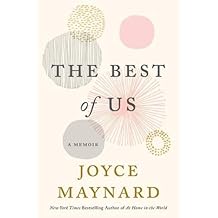
It Takes Courage to Read Joyce Maynard's "The Best of Us"
Last year I happened to catch Joyce Maynard's essay in the "Modern Love" column of the New York Times. http://nyti.ms/2ui94HD As a person whose life has been touched by pancreatic cancer, my younger brother died over two years ago from this horrific disease, my heart broke for Ms. Maynard and her husband Jim because I knew something about their outcome that they probably refused to believe at the time.
Through the generosity of so many publishers, in this case Bloomsbury, I am given the opportunity to read books of interest to me prior to their publication. "The Best of Us" will be out in September and it will join the pantheon of memoirs dealing with death and dying that will simultaneously debilitate and strengthen you. Think of Didion's "The Year of Magical Thinking" or "When Breath Becomes Air" by Paul Kalanithi.
Joyce Maynard writes with such breathtaking honesty about the joys and disappointments of her life that she has sometimes been the subject of what I see as extremely unfair criticism. This is, after all, what writers do. Their lives are fodder for the page. Fiction writers use stealth tactics but memoirists put it all out there and hope for mercy, for their humanity to be recognized.
Maynard's observations are clear-eyed and psychologically astute. When she and Jim first meet they talk over the phone for four or five hours. They lay out all their past failures and find no judgment from the other. They are adults, in their late fifties, and they are each complete in themselves, the only way to enter a relationship. When Maynard said that Jim was the first man she'd ever trusted to have her back I totally understood. If you've never had a champion in your life, a person who knows you inside and out, you cannot imagine the relief it bestows.
To finally find that kind of bliss and then, one year after their marriage, to be blindsided by a diagnosis of one of the deadliest cancers out there has to be the worst type of irony. No wonder they rebelled against the news, flying from coast to coast seeking better surgeons promising different outcomes, magical concoctions of herbs, special diets and juices, and ultimately the dreaded but longed for whipple procedure.
When and if you read this agonizing but wonderful book you may think to yourself that Maynard is exaggerating. I will attest that she is not. Each detail she shares, from the pain of being touched, to the inability to eat, to the drains and surgeries, fevers and brain fogs, and the lost look in the loved one's eyes is oh, too real. For two years I watched my brother fight, deny, withdraw, and refuse the loving care of hospice until his wife was near to a nervous breakdown herself. Like my sister-in-law, Maynard believed that only she could take the best, most tender care of the patient. They each did.
Learning about Jim through Joyce's loving eyes I once again learned how to die with grace and dignity. You cannot be given this important lesson too often. Would I have the strength to attend a Bob Dylan concert during the last week of my life so that I could say I took my beloved partner on a last date? We will never know until we are faced with these kinds of decisions ourselves. But we can read and be thankful that Joyce Maynard is an author unafraid of sharing her deepest most human thoughts with us. That trait is what separates writers from the rest of us. They should not have to fear reprisal.
Sunday, March 20, 2016
Joyce Maynard is Under the Influence
I read an editorial by Joyce Maynard in the paper a few weeks back (http://nyti.ms/1R8kEcL) and was reminded, once again, why I've been drawn to her writing for so long. If there's a certain sense of melancholy throughout most of her work, one need only read her memoir "At Home in the World," to understand why. Considered controversial when it first came out, Maynard recalls the year that she spent at a vulnerable stage in her life, living with, (under the influence of), the reclusive writer J. D. Salinger, who was thirty years her senior.
I found that the title of her latest book, "Under the Influence," actually pretty accurately describes a good portion of her life as a woman working very hard to climb out from under other people's influence.
If you happened to see the Kate Winslet film, Labor Day, based on Maynard's novel of the same name, then you'll remember the theme, sort of a Stockholm Syndrome effect, where a captive falls "under the influence" of her captor. No surprise, the book was much more believable and suspenseful, a credit to Maynard's talent as a writer.
Returning to this convention, Maynard has turned out a truly disquieting novel, in which the danger facing Helen, our very unlucky protagonist, creeps up on the reader slowly but inexorably, so that we're never sure from whence it will come or how it will manifest itself. Yet there's no doubt that it's always bubbling under the surface.
Helen, a single mom, loves her son Ollie to distraction. So it's all the more difficult to read the chapters in which she loses custody of her boy to a vindictive ex after an episode that involves too much alcohol and no friends to count on in a pinch. It could have happened to anybody, and the punishment seems outsize to the crime, but it sets us up to root for Helen's recovery and redemption.
And suddenly her luck changes. When Ava and Swift Havilland take an inordinate interest in Helen, it's almost as if she's one of their many rescue dogs. They employ her, they try to remake her over in their image, revamping her clothes, her style, her sense of self. They make her feel indispensable to their life, plying her with personal questions while revealing little if anything about their own provocative marriage. And then they hold out the carrot.
Maybe their high powered lawyer can work on her custody case as a favor. After all, since she introduced Ollie to the Havillands, the tension of the former visits between mother and son has disappeared. Ollie is enchanted with Swift, a man who rarely seems to work but has money to burn and nothing but time to shower on a kid who's desperate for attention. But we keep worrying, what's the stick?
This suspenseful novel is also psychologically astute. Maynard must have learned early on, the power of observation. Helen is a photographer. She sees people more clearly through a lens. In fact, a camera will play a large role in the denouement of this compelling story of an insecure woman who learns through trial and error to value herself above all.
Subscribe to:
Posts (Atom)

