Showing posts with label Kent Haruf. Show all posts

Friday, December 23, 2016

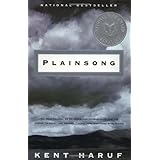
Nothing Plain about Plainsong


Product Details


I've been preparing to reread Kent Haruf's "Our Souls at Night," an exquisite little novel that I'm planning to discuss with readers at the South County Library in January. (http://bit.ly/1OurJhW) I thought I should familiarize myself with other works by this beautiful writer, dead too soon, a man who left a glorious prose legacy. "Oh my," is all I can say. I started "Plainsong" yesterday afternoon and basically did little else until I could finish it. Then I sighed with pleasure. I needed that and most likely, so do you.

Written in 1999, set in the small farming town of Holt, Colorado, this book probably best exemplifies the simpler life that so many voters, misguided as I think they were, yearned for in 2016. Haruf tells us that the word plainsong refers to any simple and unadorned melody or air. This is his milieu. No cataclysmic drama, no bloody corpse, just the vagaries of everyday life. His characters are farmers, teachers, waitresses, and secretaries just putting one step ahead of the next, not too prone to brooding or self reflection.

But of course there is drama in everyday existence, isn't there? Nine and ten year old brothers, Ike and Bobby, fear walking by their mother's closed bedroom door. A ghost of her former self, Mrs. Guthrie lays in bed for weeks on end with her face turned to the wall, incapable of being mom or wife. Tom Guthrie cares for the boys and the farm and still manages to get to work everyday at the local high school where he teaches American History.

Victoria Roubideaux isn't the first naïve seventeen-year-old (yes, in Holt they actually are that unaware) to fall for an older guy who feeds her all the sweet nothings a lonely girl wants to hear. But when she comes up pregnant and her mom kicks her down the road, fortunately she knows that a woman like Maggie Jones might just take her in and sort her out.

And then there's the eccentric McPheron brothers, Raymond and Harold, who still work dawn to dusk on their family's cattle ranch on the outskirts of town where, in a wonderfully visual chapter, the Guthrie boys learn the ins and outs of sex while helping round up the heifers for examinations and injections.

Haruf excels at creating perfect little scenes that will take readers right back to childhood when kids were left on their own all day and no one worried about them. Ike and Bobby take advantage of a lazy summer afternoon to peak through their mother's bedroom drawers, closets, and boxes, sniffing, touching, replacing items and taking others. Later they play on the railroad tracks, placing coins on the rails to be flattened, reworked by the powerful engine as it flies through on its way to somewhere else.

I don't think that Haruf implies that people were "better" back then. There are still gossips and bullies in Holt. But his love of these folk, neighbors who have to pull together to succeed, shines through from every page. They watch out for each other. They have each other's backs. They draw from seemingly endless wells of good will when the need arises. They renew our faith in what it means to be human. Oh yes, I needed that.

Sunday, July 12, 2015

Kent Haruf's "Our Souls at Night"

Product Details
 
What does that title conjure up for you? Truth and beauty was what I thought when I saw this novel on the shelf. I'd always had Mr. Haruf on my "to read" list. His trilogy which began with "Plainsong" has been highly praised. I kept telling myself, "I'll get to him, I'll get to him." Alas, Mr. Haruf died last November, but not before finishing this masterpiece of depth within a deceptively simple 179 pages.
 
Known for his glorification of small town life, Mr. Haruf writes about the people of Holt, Colorado, their daily lives and worries, small and large. Reading him could almost make one long for those days when neighbors watched out for one another and doors were left unlocked at night. Sure, everyone knew your business and that could be an annoyance, but generally they wished you well. Or at least, that's what Addie and Louis discovered.
 
I can't imagine the courage it took for Addie Moore to take those first steps, two doors down to Louis Waters' house. Both widowed, Addie and Louis had probably been watching each other for a while. How could they not when their paths crossed all the time? But that May evening when Addie knocked on Louis's door and he invited her in, the proposition she offered must have come as a bit of a shock.
 
Addie didn't pull any punches, she didn't equivocate. She told Louis the truth, that she's lonely, that she misses the warm comfort of a body beside her in bed, that she longs to talk with another person at the end of the day. Might he be feeling a similar longing? Would he consider spending the nights with her?
 
I felt such joy as I read of their awkward beginnings, Louis traipsing up to the back door of Addie's house with his pajamas and toothbrush in a paper sack. Addie offering a pre-bedtime glass of wine to calm their nerves, their gradual relaxation into routine, the lingering conversations before each drifts off to sleep, had me sighing with contentment.
 
Oh yes, the neighbors whispered at first, but as Addie and Louis became more sure of themselves and began appearing in public for lunch or a stroll in the park, the towns people accepted them as a couple, allowing them to see themselves that way too. The only problem? Their children.
 
Haruf makes astute observations about the difficulties of blending families. Why  children think that they have any right to dictate the actions of their parents has always been beyond me. More to the point, why would a parent allow his child to quarterback his decision? Don't kids trust that their folks have enough love to spread around? Or is it the money? A false sense of morality, perhaps?
 
 As Addie's and Louis's new found sense of well being is tested by the interference of her son I found myself reflecting on the many senior couples I know who followed their hearts rather than their heads and hoping that the author would imbue his characters with that same joie de vivre. This lovely, spare novel is a must read, the author's final gift to the reading world.