Showing posts with label Russia. Show all posts

Saturday, February 24, 2018

Red Sparrow - The Book or the Movie?

My friend Don and I love to listen to audio books when we are on long trips. I suggested that we download John LeCarre's latest novel, "A Legacy of Spies," since we binged out on MI-5 a few years ago. But the LeCarre has been a slog and is frankly just too complex to be appreciated when driving in seasonal traffic in southwest Florida. We found that we kept replaying sections over and over again to "get it."

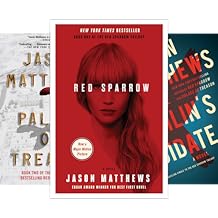
The Red Sparrow Trilogy (3 Book Series)Then we went to the movies and caught a preview of Jennifer Lawrence's new project, "Red Sparrow." Don is no fan of JLaw but he's half in love with Charlotte Rampling who also appears in the film. We decided to give the book a try and read it simultaneously. I was a bit surprised that the author, Jason Matthews, used his own name, since he was a highly placed CIA operative for over thirty years and participated in clandestine recruitment operations around the globe. The authenticity of the novel makes for a fast-paced read that, even with some gratuitous violence, fills the bill for escapist lit.

Appropriately enough, Russia is the villain in this book. The action centers around CIA agent Nathaniel Nash, who's been the handler for a highly placed mole in the Russian bureaucracy. MARBLE, the spy, is aging and worries that his days as an informer are numbered. He would like to retire but the U.S. can't afford to relinquish this font of information.

Dominika Egorova is a Russian ballet prodigy whose talent and beauty draws the ire of her rivals, resulting in a Tonya Harding type attack which halts her career. In a humiliating fall from grace, and to ensure that her widowed mother is supported, Dominika follows her uncle's advice and applies for the Sparrow program in which young women are trained in the art of seduction in order to elicit information for Russian intelligence services.

Matthews often allows his condescending opinions of Russian spycraft to leak through his narrative, a common fault of Americans to underestimate our rivals, and one that we've recently learned can be truly detrimental to democracy. But the author does proffer the interesting premise that Dominika was born with a neurological disorder called synesthesia which enables her to read body language, see auras, and excel at math and languages. Not satisfied with being a glorified prostitute, Dominika parlays her intuitive talents into government promotions that put her and Nash on a collision course.

Several secondary characters stand out in this thriller, both Russian and American, and trying to decipher who's the valuable mole was great fun. I'm not sure if Don or I figured it out first. But what some reviewers found to be a distraction we most delighted in. Each chapter centered around a meal. I thought it was a device of the author's to indicate that no matter how close one is to danger, even death, the urge to nurture our bodies and enliven our conversations around the sharing of food never slackens. At the end of each chapter the author shares the recipe for whatever was eaten by his characters. Even in a safe house, awaiting news of an operation, Dominika recreates her family's comfort foods.

"Red Sparrow" is the first in a trilogy. I moved on to other realms but Don is sticking with it and promises that I'll soon be having Chicken Kiev for dinner. The film will be released next week. It may not be as cerebral as LeCarre but it will keep you up past your bedtime.

Saturday, September 17, 2016

A Week's Vacation with A Gentleman in Moscow

Last week a perfectly marvelous new novel was launched into the world. "A Gentleman in Moscow" defies categorizing. No simple genre classification could contain the wealth of knowledge and pleasure that readers will gain from taking their time and savoring this literary masterpiece.

The author, Amor Towles, http://www.amortowles.com/amor-towles-bio/ wowed the critics with his debut, "The Rules of Civility," which came out a few years ago and has been optioned for a film. I enjoyed it very much, but this new book is written on an entirely different level. Isn't it a joy when a writer gets better with age?

Product Details
 
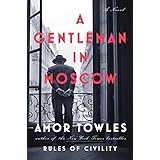
When I first laid eyes on the cover of the book, I made the incorrect assumption that I would be delving into a John Le Carre type of espionage tale. And yes, there certainly are thrilling moments of political intrigue. But there is so much more.  You will actually witness a half century of Russian history through the eyes of Count Alexander Ilyich Rostov, as companionable a fictional character as you'll ever meet. You will be treated to a cri de Coeur for a way of life that may be obsolete but not forgotten.
 
Count Rostov appears before the People's Commissariat for Internal Affairs in June, 1922, charged with penning a poem that might be considered subversive. The Count, a member of the "leisure class," had exiled himself to Paris at the height of the revolution, suddenly returning to Moscow to take up residence in the luxurious Metropol Hotel, after the destruction of his family's country estate.
 
Upon questioning from the panel now deciding his fate, Rostov is asked about the nature of his occupation. He replies imperiously that, "It is not the business of gentlemen to have occupations."
 
"Very well then. How do you spend your time?" his interrogator queries.
 
Rostov states, "Dining, discussing. Reading. Reflecting. The usual rigmarole."
 
How can you not love this guy?
 
Rostov is found guilty and, oh joy, he is sentenced to a lifetime of confinement in, you guessed it, The Metropol. If he attempts to leave, he will be shot on sight. And so begins our thirty year relationship with the count and his cadre of fascinating friends, the seamstress, the waiters, chefs, concierge, and janitors who will always revere him as "your excellency." Though his circumstances are grossly reduced, from a luxury suite on the fourth floor to a single room with a closet in the attic, he is revered for his discernment, wit, and seeming blindness to class structure.
 
Over time the count, because of his intellect, curiosity, and kindness, thrives in confinement, managing to meet and form long-term relationships with artists, poets, and politicians from around the world. He nurtures a lengthy love affair with a famous beauty, the actress Anna Urbanova, and even becomes a doting father.
 
Towles subtly contrasts the idyllic life within the hotel to the bare existence of the Russian people as they struggle under Lenin, Stalin, and the rapacious building of the Soviet Union. The count represents a time when Russia was in its golden period, when the appreciation of glorious music, literature, and creativity was a raison d'etre. And though he eventually becomes an employee at the Metropol, he cultivates pride in every task required of him, exalting the menial.
 
Amor Towles has pulled off something rare in the book world today, a unique story, luminously written, deliciously subversive, and inhabited by people we wish we could spend more time with. I can't wait to share my copy so that I can talk about it with you. "A Gentleman in Moscow" has now become my second favorite book of the year after Nathan Hill's "The Nix."