Wednesday, May 27, 2015

David Hare's "Skylight" on Broadway

Last Wednesday Don and I left our hotel in Massachusetts in forty degree weather and headed to the Amtrak station in Hudson, New York. We had not packed for such a blustery day. The thirteen block hike from Penn Station to the John Golden Theatre brought tears to my eyes. Bill Nighy! What we did for you!

I've been a fan since I saw him - five times - in "Love Actually." Then we discovered "The Worricker Trilogy," a fun little BBC espionage series. Now we just check IMDB and go down the list ordering everything that he's in. We were primed to love "Skylight" having read the outstanding reviews and paid the sinfully high price of the tickets. What we weren't quite prepared for was to look at each other after the play and say "what did we just witness?"

All the way home we tried to analyze the play, in its third iteration by the way, having been mounted on the London stage twice before this rendition. Was it a political screed? A romance? One review I found stated that Hare was writing about the aftermath of the Margaret Thatcher administration and its disastrous effects on so many Brits. The divide between the 1% and everyone else came early to Great Britain. Perhaps now was the perfect time for the play to find its way to the United States and why it resonates so well with audiences here.

It certainly is a marvel to watch two renowned professionals plying their craft. Bill Nighy and Carey Mulligan were each outstanding in their own very divergent ways. However I felt as if each was performing a monologue, playing to the audience rather than to each other. The two characters (and actors) Tom and Kyra, are probably more than thirty years apart in age so it pushed the envelope to try to imagine them as lovers of six years, torn apart when discovered by Tom's wife, who was also Kyra's best friend.

Of course, it's much more complicated than that. At various points during the play, audience allegiances shift from Kyra to Tom and back again as the actors reminisce, cry, rant, and try to regain a connection that maybe wasn't that strong in the first place. Now that Tom's wife has died of cancer, he seems torn between grief over the loss, and anger that she denied him the forgiveness he craved since his betrayal with Kyra.

Kyra, on the other hand, implies that the love affair, for her, was with Tom's whole family and not simply with Tom himself. When she says he's the only man she's every loved, she does not speak with conviction. A flaw in the writing or just in the star's interactions? I'm not sure.

Nighy, as the wealthy, high strung, type A restaurant owner is like a stalking lion, all over the stage, as he berates Kyra for not living up to her potential, by which he means, not becoming the woman he could love in the clear light of day. She has subsumed herself in guilt, eschewing all the luxuries Tom could have offered for the life of a broke teacher, living in an aggressively ragged one-room sublet on the wrong side of London, where she struggles to identify one or two bright students that she can encourage and mother, out of the classroom full of kids who will never be able to drag themselves out of hunger and poverty.

The tension that builds between the two begins to feel less sexual and more parental as Nighy, in frustration, lunges for the homework booklets that Kyra was grading when he abruptly entered her apartment. As he shoves over furniture and strews the precious work of the young students across the room, the audience recognizes that this pair will never be able to repair the rift. And a disconcerting yet powerful afternoon at the theatre came to an end. Now, if I could just understand the symbolism of the skylight. 

Saturday, May 23, 2015

Hitting the Road with Books

It appears that May, the lusty month of May, will permanently be my month to be off the grid. It's a crazy month of last lunches and get-togethers in Florida followed by reunion luncheons and get-togethers in Maryland. There's a home to close and another to open, gardens to put to bed and others to plant. It's also the month that I make my annual trek to Massachusetts, state of my birth, to visit with my Aunt Jackie and sister Cynthia for a week.

 
This year was special as it was my Aunt Jackie's 90th birthday and we had planned a surprise party for her. (she's the one in the peach shirt) Yes, I can only hope that I've inherited her genes.

I suppose it was especially fitting that I was reading Anne Enright's "The Green Road" on the run up to that week. Our family, as much as I've tried to deny it all my life (convinced that I'm Italian), has more than a tad of Irish in it and difficult Irish families are Enright's forte. She won a Man Booker award for her wonderful novel "The Gathering," about a family coming home for a wake, and I suspect she will be nominated again for her latest novel even if the subject matter sounds trite. In this case, the family is summoned home for Christmas.

The Irish are renowned for their storytelling prowess, just think of Frank McCourt, Colum McCann, or Colm Toibin. Anne Enright is no exception. If you love lyrical phrases and sharp humor, Enright is your girl. But, if you get frustrated with characters who immediately revert to four-year-olds when they rejoin the bosom of their family, you may decide to stay away.

Rosaleen, the matriarch of the Madigan family, takes to her bed in anguish when her favorite son Dan announces that he plans to join the priesthood. That's a rare reaction from an Irish mother. Certainly my aunts encouraged our cousin George in his delayed vocation. Over the span of thirty years we live with each of the four Madigan children as they struggle to make their way in the world, eschewing the ties that bind them to Rosaleen and County Clare.

Constance marries a kind, loving man with a knack for making money and becomes the quintessential Irish version of a soccer mom, running the kids this way and that in her fancy Lexus, while ballooning in weight, a metaphor for the excess that surrounds her. Emmet, takes the opposite tack, heading to Mali in Africa to work with an NGO that provides for with those who have little or nothing. Hanna finds that having a baby does little to fill the pain in her psyche that only vodka can assuage and Dan, having given up the seminary, lives in New York City where he is free to come out as a gay man yet faces the scourge of the 80's HIV crisis.

So when the resilient Rosaleen, now widowed, decides that it's past time to sell the family manse and simplify her life, she sends her annual Christmas cards with a passive-aggressive taint to the message. She expects them all home in Ireland for Christmas this year.

Could four more disparate siblings convene for a holiday? Can they find common ground? Is there an innate love between brothers, sisters, and parents that surfaces no matter the past disappointments and hurts? Can we eventually accept each other as friends? Enright may answer these questions but she'll raise even more as she brings this fractious family to life on the page.

Thursday, May 7, 2015

The Sympathizer

the sympathizer-new

Serendipity is a wonderful thing. The library had my copy of Viet Thanh Nguyen's first novel, "The Sympathizer," available last week just as Don and I settled down to watch Rory Kennedy's PBS special marking the fortieth anniversary of the fall of Saigon in South Vietnam. It stirred so many memories for each of us, his as an Army private stationed there in the early days before the worst of the fighting, and mine as a spoiled college kid protesting the escalation of the bombing from the relative safety of the streets of D.C.

Of course, we both arrived at the same place. We have a deep empathy for the Vietnamese people and some measure of remorse and even shame at what the American armed forces, not the guys on the ground, but the brass at the Pentagon, did to this small but mighty country in the name of fighting Communism.

Nguyen's family fled North Vietnam for the south ahead of the Communist push, and when he was only four, they escaped to America where he received a stellar education and pursued a noted career in academia. http://vietnguyen.info/
This sophisticated and technically exceptional novel begins with the narrator confined to a prison cell, in solitary confinement, where he is writing a "confession." The confession begins on that April day forty years ago when, depending upon who one knew and how much money one had, some would be evacuated from Saigon as the northern armies moved in.

The narrator is the right hand man and trusted confidante of a general who is in thrall to the United States and all it stands for. The general still cannot believe that South Vietnam is being abandoned, no money, no arms, no men, to fend off the north while the American ambassador and his cronies board jets to safety. But, with the help of Claude - CIA perhaps? - the general secures passage to the states, and because our narrator is a spy, he too will be flown out so that he can keep an eye on the general.

Confused? Well yes, this is a book that requires your attention. On the surface it's a thriller, espionage, but it is so much more. Nguyen may have only been four when he came to the states but he has obviously examined the physical and psychological ramifications of the migration experience of the Vietnamese people in depth. I suspect that the fact that Nguyen's central character is a spy, a man of two minds if you will, speaks to the fact that no matter how well an immigrant succeeds in his adopted country, there will always be a yearning for the origin, for his roots.

This is also a novel about three friends, Bon, Man, and our narrator, about loyalty to one's country and loyalty to one's blood brothers. It's a novel about the moral quagmire that is torture, its efficacy, its history, and sadly, how it was introduced to the Vietnamese by the United States.

"The Sympathizer" is a gorgeously crafted work of art. Each sentence is a gem. With just a few words Nguyen proffers a world of wisdom. He zings us with ironic statements that are spot on without being mean-spirited. We see only truth in the uncomfortable facts he writes about. I don't doubt that this novel will appear on many "best of" lists for 2015. Yet, for me, there is something missing.

I can't find the beating heart of this book. It seems too clinical, lacking in a soul, minus the empathy one would expect from an author recounting the demise of his homeland. As I've mentioned before, I hold every novel of Vietnam up to Karl Marlantes' "Matterhorn," a book that touched me at my core. While "The Sympathizer" has much to recommend it, especially for those interested in how governments wage war on the backs of those least able to sustain it, I fear that what's absent is the sympathy.


Thursday, April 30, 2015

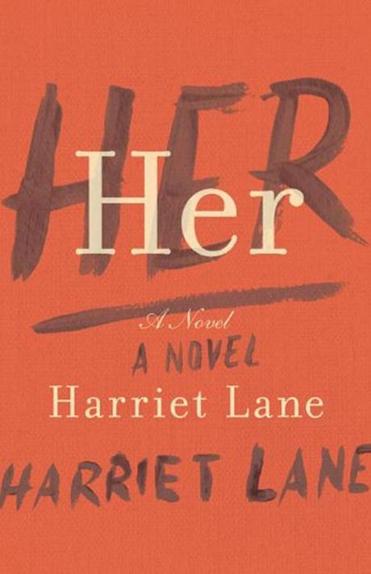
The Banality of Evil in "Her"

41KzvDb9htLHarriet Lane's first novel, "Alys, Always," was a heart knocking psychological thriller that I read in one afternoon. http://readaroundtheworld-sallyb.blogspot.com/2012/07/alys-always-i-found-it-first.html
Imagine how pleased I was to see that Ms. Lane had quickly followed up on her early success. The minute my obligatory reviews for the radio program and for Library Journal were completed for this month I sat back expecting to be blown away once again. Alas, it was not to be.

"Her" requires a bit more investment in time.  Lane brilliantly writes about the frustrations of Emma, a London career woman who has forfeited the good life for domestic tranquility, two kids and a less successful husband. Lane perfectly describes the dichotomy between a mother's pleasure at the touch of her baby's skin and her rising anxiety level when that same baby is screeching at high pitched decibels for the unknown. I doubt that there's any mother reading this who won't empathize with the harried Emma as she pushes the infant in the unwieldy pram while trying to keep her eyes on the toddler with his trike. Danger can come from anywhere, at any minute.

But whenever Emma seems to be at the end of her rope, Nina is there with the lifeline. How is it that this neighbor, professional artist, svelte, polished, put-together Nina, becomes Johnny on the spot? She "finds" Emma's lost wallet, she "discovers" the missing toddler Christopher on her front steps, she slowly insinuates herself into Emma and husband Ben's lives until she is almost indispensable, even offering ten days away from the madding crowd at her family's summer home in France. Why her?

And therein lies the problem with this entertaining but hardly heart knocking psychological thriller. It simply takes too long to ratchet up the tension. Every other chapter is a repeat of the one prior, so that Emma tells her version of an incident and then Nina offers the same tale from her perspective. But the differences are just too nuanced and the risk of boring the reader is simply too great.

Revenge has historically been the motivation for some horrific acts of violence yet often it is the minor injury we commit, without even being aware, that settles in a twisted person's psyche and percolates for years. How can we defend ourselves, apologize for, or even acknowledge our offense if we are oblivious to it? Perhaps that's the banality of evil that Harriet Lane would like us to think about. Have you read this novel? What did you think? Agree? Disagree? Let's talk.

Saturday, April 25, 2015

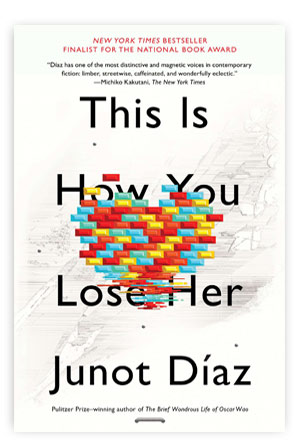
This is How You Lose Her

There is only one way to be introduced to Pulitzer Prize winning author Junot Diaz ("The Brief Wondrous Life of Oscar Wao"). You absolutely must listen to him. After finishing his short story collection, "This is How You Lose Her," yesterday afternoon, I mucked about the Internet enthralled by all of the interviews and lectures that I found. These interactions give you a feel for the man and for what a delight it must be to land in one of his writing classes.

This is how you lose her
Diaz is a writer who does not hold back. Be prepared for a wild ride if you decide to jump into his work. Born in the Dominican Republic and transplanted to New Jersey, now living in Boston, Diaz writes in a funky patois, half English, half Spanish, with an overridingly heavy Jersey accent. If you're squeamish about four letter words, he's especially liberal with the one that begins with "f," then you might have to stay away but, honestly, you'd be doing yourself a disservice.
 
Reviewers pretty much concur that Yunior, the narrator of these tales, is Diaz's alter ego. I thought as much while listening but kind of hoped it wasn't true because, as hilarious as these stories are, (I often found myself stopped at a light and laughing out loud to the consternation of my fellow drivers) there is an unmistakable air of melancholy and loneliness running underneath the surface.
 
One story recounts how Yunior, his older brother Rafa, and their mom, finally came to the United States after waiting for their dad who had been here and working for quite a while, to send for them. Dad had no idea how to deal with his two little boys. They had never actually lived with him and he had strict Dominican ideas of how to deal with women and children. Think seen and not heard.
 
For an entire winter, Diaz recalls, they were confined to a small apartment with nothing but a TV for company, while they peered out the window to see other kids their age having snowball fights and running wild and free. When the little cutie next door waved at him through his frosted pane for the umpteenth time, Yunior decides to make a break for it knowing he'll pay when his dad gets home but also sensing that it'll be worth it.
 
Most of the stories though are about men and women, the dating and mating dance, the misunderstandings, the miscommunications, the extremely angst-filled game that so many play as they begin that endless quest for "the one." And Yunior? Well, he has a problem. As his posse says, he just can't keep it in his pants. Whether he's sleeping with the neighbor who's old enough to be his mom, or with his brother's girl, he's always got more than one thing going at a time. And when he's caught out? Well, that the subject of another story.
 
Junot Diaz is also very conscious of his position as a writer of color. In fact he founded an organization called VONA http://www.voicesatvona.org/Home.html
Observations on the immigrant experience, race and gradations of color are present in all of his stories and are addressed in very funny but ironically truthful ways. I don't have any way of knowing if Diaz's take on the world of love and marriage for the forty-something crowd is accurate but, if you've got the courage to delve into it, it's an eye-opener for sure.