Showing posts with label
Georgia - race relations - fiction.
Show all posts
Showing posts with label
Georgia - race relations - fiction.
Show all posts
A shout out to friend and avid reader Pat Abosch for recommending that I introduce author Jonathan Rabb to my repertoire. A professor of literature, currently at Savannah College of Art and Design, Rabb may have gotten the idea for "Among the Living," which was first published in 2016, from the glorious Savannah campus where the student center was once the first major synagogue in the city.
From the 1700's the city of Savannah was a haven for a burgeoning Jewish population which separated itself into Reform and Conservative factions and never the twain should meet. This irony, the fact that religious groups who all ostensibly worship the same god, discriminate against each other is hardly lost on this recovering Catholic who tempted god mightily by daring to sneak into a Congregational church once during my inquisitive youth. Mr. Rabb addresses this and many other important themes in this beautifully written novel.
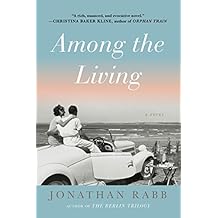 For Yitzhak Goldah, arriving in 1947 at the Savannah home of cousins he's never met, it's a question of surviving versus actually living. Among the well-heeled friends of the well-meaning Jeslers, Abe and Pearl, Yitzhak is an object of pity and discomfort. Recently released from a German prison camp, Yitzhak cringes each time someone offers him too much food, takes him shopping for new clothes, and studiously avoids speaking of the elephant in the room.
The Jeslers are shocked when Yitzhak declines to attend Sabbath services, unable to imagine that he might no longer be a believer. They advise that things will go "easier" for him if he has a more American name, deciding on Ike.As "Ike" tries to assimilate into Savannah society, working at Abe Jesler's shoe store, he marvels at the naivety of the American people, at their inability to remotely fathom what happened back in Poland and Germany. He finds he has more of an affinity for the black people who work in the Jesler's kitchen and in the back room of the store.
And then he meets Eva, a war widow with a young son, who sees in Ike a man, kind, interesting, smart, and not just a symbol of the Holocaust. As their relationship deepens we sense that Eva might be the person who can restore Ike to the land of the living unless a surprise arrival from his past and the power of survivor guilt intrude on his new life.
The Jim Crow south, the publishing industry, northern union influence on southern businesses, and cultural and religious identity are all part and parcel of this deeply affecting book from a master storyteller. I did not want it to end.
For Yitzhak Goldah, arriving in 1947 at the Savannah home of cousins he's never met, it's a question of surviving versus actually living. Among the well-heeled friends of the well-meaning Jeslers, Abe and Pearl, Yitzhak is an object of pity and discomfort. Recently released from a German prison camp, Yitzhak cringes each time someone offers him too much food, takes him shopping for new clothes, and studiously avoids speaking of the elephant in the room.
The Jeslers are shocked when Yitzhak declines to attend Sabbath services, unable to imagine that he might no longer be a believer. They advise that things will go "easier" for him if he has a more American name, deciding on Ike.As "Ike" tries to assimilate into Savannah society, working at Abe Jesler's shoe store, he marvels at the naivety of the American people, at their inability to remotely fathom what happened back in Poland and Germany. He finds he has more of an affinity for the black people who work in the Jesler's kitchen and in the back room of the store.
And then he meets Eva, a war widow with a young son, who sees in Ike a man, kind, interesting, smart, and not just a symbol of the Holocaust. As their relationship deepens we sense that Eva might be the person who can restore Ike to the land of the living unless a surprise arrival from his past and the power of survivor guilt intrude on his new life.
The Jim Crow south, the publishing industry, northern union influence on southern businesses, and cultural and religious identity are all part and parcel of this deeply affecting book from a master storyteller. I did not want it to end.
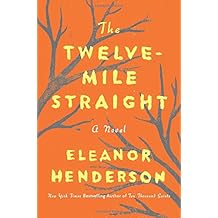
My sister and I were chatting on the phone last night when I mentioned that it had been a while since a new novel had really grabbed me. We both tend to the dark side in our reading but still I warned her that the book that had me at hello begins with a lynching. She said she was reading one that begins with a lynching. Sure enough...."The Twelve Mile Straight" held us both in thrall.
I kept asking myself, how could a writing professor from Ithaca College create such an evocative sense of place as 1920's rural Georgia. I went to Henderson's website for answers (http://eleanor-henderson.com/) and discovered that this amazing novel was informed by the lives of her father and grandparents who were sharecroppers in Ben Hill County, Georgia, during the same time frame.
Eleanor Henderson's outstanding book has much to say about the sin of silence. When Elma Jesup, the white daughter of a sharecropper in fictional Cotton County, Georgia, supposedly gives birth to twins, one black and one white, it is her silence that condemns Genus Jackson, the black farmhand accused of rape.
How else, town folk wonder, could Elma be carrying the white child of her fiancé, Freddie Wilson, who never intended marriage and now had a perfect out, and a black child too. Reporters from as far away as Atlanta flock to Cotton County to write about this miracle, doctors beg to study the twins, and the only people who know the truth remain steadfastly silent.
Only a writer of considerable talent could turn this fantastical premise into a heartbreaking story about the interwoven lives of poor black and white southerners working the farms together to create wealth for the landowners. She exposes a precarious hierarchy of power. The Wilson family rules the county, the police, the politicians, even the local physician, Dr. Rawls, who keeps his practice afloat by performing abortions for the naïve young women who came to town to labor in Wilson's cotton mills.
Carrying the story are two marvelously drawn characters. Elma's mother died in childbirth so she is raised by the black midwife and housekeeper, Ketty, whose daughter Nan grows up as Elma's sister. Though Nan reads and writes and learns the trade of midwifery too, the balance of power between Nan and Elma is a constant. You see, Nan literally has no tongue, and though she and Elma have developed a nuanced means of communication, there are many times over the course of their lives together when the white girl, speaking for the black girl, gets it horribly wrong.
There are too many villains to count in Henderson's novel, yet she manages to imbue even the worst of these with a semblance of humanity. One especially powerful scene comes to mind. Elma's father Juke is in a jail cell awaiting trial for his part in the lynching of Genus Jackson. He is comforted by the sounds of gospel singing, low and strong, coming from the black woman in the adjoining cell. Later he hears her cries of anguish as she is raped by the jailer, so he sings a lullaby for her. In this one paragraph Henderson brilliantly opens a place in our hearts for forgiveness.
This strong novel, perfect for sophisticated book clubs, delves into the polio epidemic with a guest appearance from then Governor of New York Franklin Roosevelt, sickle cell disease and the dearth of funding for research, homosexuality, misogyny, class inequity, and of course, racism. At the same time this novel is a paean to the strength and resilience of women in particular, but to all who are victimized by the evil of discrimination in its many forms.