
Readers who have been following this blog for a while may remember that The Unlikely Pilgrimage of Harold Fry was at the top of my favorites list last year. In fact, I'll be leading the book discussion of Rachel Joyce's debut novel at the South County library next winter. So naturally, when I read that she had a new novel coming out in January - yes, sorry, you'll have to wait until 2014 - I immediately asked for a copy from the good folks at Net Galley.
Harold was one of the first characters to make me cry in a long, long time. Diana Hemmings, the tragic figure in Perfect, didn't make me sob out loud but she tore my heart out just the same. In fact, the basic similarity between Ms. Joyce's first and second novels is that they are both peopled with such lost and lonely souls desperately in need of connection.
The other day I read an article in the New York Times about the president of Barnard College http://www.nytimes.com/2013/09/15/fashion/finding-satisfaction-in-second-best.html?pagewanted=all&_r=0 in which she discusses the downside of the feminist revolution, the fact that we gals now seem forced to seek perfection in everything we do. Having it all means being the perfect employee, manager, mom, wife, etc. Under that kind of enormous pressure, something's got to give. I though of Diana Hemmings right away.
Rachel Joyce has created in Diana such a fragile creature that I actually got sympathy knots in my stomach when her husband Sylvester got off the train each Friday afternoon at precisely the same time. The children who, during the week while daddy is away on business, laugh, play, and dwell happily in their imaginations, become silent, sullen, and nervous the second he gets in the car.
Though she's dressed with caution, not a hair out of place, Sylvester's favorite style includes a pencil skirt, modestly heeled shoes and a demure silk blouse, Diana can do nothing right under his cold scrutiny. Why, we might wonder, would she live like this, even keeping in mind that it is only 1972?
Is it the lovely home on the English moors, the freedom from financial worries, or the new Jaguar sitting in the garage? Painfully, slowly, Ms. Joyce metes out the information to her readers so that we get to know the other Di, the one who was less than "perfect.".
The narrator is Diana's precocious son Byron, an eleven year old boy who's as sensitive and bright as his mother, and one who worries about everything. In fact, it is one of these big worries, that the international clock at Greenwich will lose two seconds during the course of the year, that is the catalyst for a split-second accident that will reverberate through the lives of all the characters down to current times.
This novel involves two stories told in alternating chapters that don't seem to correlate at all when you begin reading. Do stay with it. When it all makes sense, I hope that you'll be as shocked as I was.
The author has an exquisite way with words, a deep empathy for the human condition, and amazing insight into the mysteries of the heart. A wonderful read indeed.
Monday, September 16, 2013


Thursday, September 12, 2013
Sweet Affirmation! Times Two
Just a few weeks ago I used this platform to bemoan the fact that, as a reviewer, I often question myself. So it was with trepidation that I looked at last weekend's cover review in the New York Times of Coetzee's The Childhood of Jesus, a novel that I've mentioned, I found to be indecipherable. What, I kept asking, was the author really trying to say?
The Times review was written by none other than the inimitable Joyce Carol Oates. Of course, writers like Oates are not limited to 225 words, so I jumped right to the last paragraph of the three page spread and found that, in much kinder words, Ms. Oates asked the same question I had, what the hell is this author really trying to say? Ya gotta love it.
I was so thrilled to read that another novel, one that I really loved and wanted to tell you about, has just been added to the short list for the prestigious Booker Prize. Such validations are absolutely necessary for a reviewer - at least for this one. I couldn't keep going if I didn't feel that I got it right way more often than I got it wrong. Who would trust me?
Zimbabwean author NoViolet Bulawayo's first novel, We Need New Names, is the Booker nominee that I'm talking about.
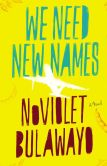
Snap up a copy as soon as you can so that you, too, can be on the inside track when the awards are announced next month. Here's the review I wrote before I was assured that it would be a hit.
The Times review was written by none other than the inimitable Joyce Carol Oates. Of course, writers like Oates are not limited to 225 words, so I jumped right to the last paragraph of the three page spread and found that, in much kinder words, Ms. Oates asked the same question I had, what the hell is this author really trying to say? Ya gotta love it.
I was so thrilled to read that another novel, one that I really loved and wanted to tell you about, has just been added to the short list for the prestigious Booker Prize. Such validations are absolutely necessary for a reviewer - at least for this one. I couldn't keep going if I didn't feel that I got it right way more often than I got it wrong. Who would trust me?
Zimbabwean author NoViolet Bulawayo's first novel, We Need New Names, is the Booker nominee that I'm talking about.
Snap up a copy as soon as you can so that you, too, can be on the inside track when the awards are announced next month. Here's the review I wrote before I was assured that it would be a hit.
Library Journal
Caine Prize-winning Bulawayo's debut novel opens in a Zimbabwean shantytown called Paradise, where life is a daily struggle for sustenance as the regime destroys homes and closes schools. As ten-year-old Darling and her friends roam the streets, turning their quest for food into a game, Darling makes wry observations about her country's social ills that belie her tender age. Given the opportunity to move to Michigan with her aunt Fostalina, Darling faces a different challenge: how to transition from abject poverty to ostentatious excess. With an acute sense of irony, she observes refrigerators stuffed with food even as the women diet rigorously to fit into Victoria's Secret underwear and the dog whose room is larger than most homes in Zimbabwe. In a poignant scene, Darling sniffs at a guava and is transported to her homeland. VERDICT As Bulawayo effortlessly captures the innate loneliness of those who trade the comfort of their own land for the opportunities of another, Darling emerges as the freshest voice yet to spring from the fertile imaginations of talented young writers like Chimamanda Ngozi Adichie and Dinaw Mengestu, who explore the African diaspora in America. [See Prepub Alert, 11/19/12.]—Monday, September 9, 2013
Surveillance and Flanery's Fallen Land
Mea culpas to my readers as I've been offline for over a week. Facebook aficionados will know my whole life story even though I didn't post a word! My sister was here in Maryland for a visit and we then proceeded to drive to Erie, Pa. for my nephew's wedding. The entire family had a fantastic Labor Day weekend and things went off without a hitch. How lovely to see the little ones, growing faster than is even comprehensible. Are the twins actually walking already?
On we went to my hometown of Great Barrington, in the Berkshire hills, recently named "best little small town in America" by Smithsonian magazine. What a laugh. This precious town is currently nothing more than an unaffordable bedroom community for New Yorkers. Our old "homestead," barely standing it's so run down, cost my folks around $12,000 when they purchased it back in the '60's. It was considered pretty upscale. It last sold for close to $300.000 to a man who leases it out to students at the local branch of Bard College. Thank goodness my dad can't see his once gorgeous yard now.
So what was I reading while on the road you might wonder. A very disappointing John Le Carre, A Delicate Truth, failed to live up to its hype and, in deference to my Civil War manic sister, I'm struggling through Doris Kearns Goodwin's Team of Rivals. I'm confident that it will become more interesting once we get to Washington but life in the early days of Seward and Bates, contenders for the seat that Lincoln eventually won, is not exactly heart-stopping reading.
What did knock me out is the one that I couldn't talk about until the review had been published in Library Journal, which it was, in the 9/1 edition that was waiting for me when I got home to Maryland Saturday night. Yes! Keep you eyes out for this one by Patrick Flanery.
Throughout my reading of this novel, Fallen Land, I could think of nothing else but Edward Snowden. Whether you believe he's a villain or a hero, and of course I would tend to the latter, his revelations about the depth of the spying taking place by the NSA should have come as no surprise to thinking people everywhere. Hoover started it all during the so-called "red scare" of the '50's and it's been insidiously growing since then.
Some little part of me said it was no big deal. You know, if you've got nothing to hide....but the librarian side of me thought, whoa, think of the damage that false or misinformation can do. What if something one writes or says is misinterpreted? Remember when you were a kid and played Telephone? How easily a phrase or sentence can be changed simply by inflection or with deliberate intent.
Here's a copy of my review. Please add this to the top of your "to read" list!
In compelling prose, Flanery (Absolution) unveils the insidious growth of defense contractor EKK Corporation into a global big brother intent on managing all aspects of people's lives. At the crux of this intense narrative are Paul Krovik, a failed building contractor whose paranoid delusions have alienated his family and left him holed up and armed in a bunker under the house that he considered his masterpiece, and EKK executive Nathaniel, the usurper who now lives with his wife, Julia, and son, Copley, in Paul's former home. Confusing Copley with his own son, Carson, Krovik steals into the house at night in a misguided effort to watch over the lonely boy. But when Copley warns his parents of this strange presence, they fear for his emotional health. Julia turns to former schoolteacher Louise, the granddaughter of sharecroppers, who inherited the land on which Krovik's planned community was built. Burdened with medical bills after her husband's death, and with her home in foreclosure, Louise needs a place to live, and Copley needs an advocate. VERDICT In alternating chapters, Flanery gives every character a nuanced inner voice, allowing the reader to empathize with, if not fully understand, the actions of each. This is a tense, gut-wrenching take on the American dream gone horribly awry.—
On we went to my hometown of Great Barrington, in the Berkshire hills, recently named "best little small town in America" by Smithsonian magazine. What a laugh. This precious town is currently nothing more than an unaffordable bedroom community for New Yorkers. Our old "homestead," barely standing it's so run down, cost my folks around $12,000 when they purchased it back in the '60's. It was considered pretty upscale. It last sold for close to $300.000 to a man who leases it out to students at the local branch of Bard College. Thank goodness my dad can't see his once gorgeous yard now.
So what was I reading while on the road you might wonder. A very disappointing John Le Carre, A Delicate Truth, failed to live up to its hype and, in deference to my Civil War manic sister, I'm struggling through Doris Kearns Goodwin's Team of Rivals. I'm confident that it will become more interesting once we get to Washington but life in the early days of Seward and Bates, contenders for the seat that Lincoln eventually won, is not exactly heart-stopping reading.
What did knock me out is the one that I couldn't talk about until the review had been published in Library Journal, which it was, in the 9/1 edition that was waiting for me when I got home to Maryland Saturday night. Yes! Keep you eyes out for this one by Patrick Flanery.
Throughout my reading of this novel, Fallen Land, I could think of nothing else but Edward Snowden. Whether you believe he's a villain or a hero, and of course I would tend to the latter, his revelations about the depth of the spying taking place by the NSA should have come as no surprise to thinking people everywhere. Hoover started it all during the so-called "red scare" of the '50's and it's been insidiously growing since then.
Some little part of me said it was no big deal. You know, if you've got nothing to hide....but the librarian side of me thought, whoa, think of the damage that false or misinformation can do. What if something one writes or says is misinterpreted? Remember when you were a kid and played Telephone? How easily a phrase or sentence can be changed simply by inflection or with deliberate intent.
Here's a copy of my review. Please add this to the top of your "to read" list!
Library Journal
★ 09/01/2013In compelling prose, Flanery (Absolution) unveils the insidious growth of defense contractor EKK Corporation into a global big brother intent on managing all aspects of people's lives. At the crux of this intense narrative are Paul Krovik, a failed building contractor whose paranoid delusions have alienated his family and left him holed up and armed in a bunker under the house that he considered his masterpiece, and EKK executive Nathaniel, the usurper who now lives with his wife, Julia, and son, Copley, in Paul's former home. Confusing Copley with his own son, Carson, Krovik steals into the house at night in a misguided effort to watch over the lonely boy. But when Copley warns his parents of this strange presence, they fear for his emotional health. Julia turns to former schoolteacher Louise, the granddaughter of sharecroppers, who inherited the land on which Krovik's planned community was built. Burdened with medical bills after her husband's death, and with her home in foreclosure, Louise needs a place to live, and Copley needs an advocate. VERDICT In alternating chapters, Flanery gives every character a nuanced inner voice, allowing the reader to empathize with, if not fully understand, the actions of each. This is a tense, gut-wrenching take on the American dream gone horribly awry.—
Tuesday, August 27, 2013
Elsewhere by Richard Russo
If they were believers, I would say that Barbara (especially her) and Richard Russo, one of my all-time favorite authors, should be canonized. It took me a long time to figure out why Russo felt that he had to pen this memoir, which revolves around his mother, Jean, her emotional instability, and its effects on her son and his wife. I suppose that it was cathartic in a way that spreading her ashes in the waters off Martha's Vineyard was not.
I believe that most of us tend to soften our views of our personal history as we age. I know that I certainly see my mom in a different light now, almost thirty years after her death, than I did as a younger woman. And the book that I might write about her now would be a much more compassionate one than the one I might have written when I was thirty and we were still, it seems, at loggerheads.
Richard Russo lived the burden of being an only child which likely added to his sense of responsibility where his mother was concerned. His father had exited the picture early on because he understood that his wife was - his term - crazy. In fact, she was mentally ill with at least two separate disorders that would be rather easily treated today. In the '40's and '50's what Jean Russo suffered from was "nerves," an affliction that was underestimated and over medicated.
The reviews for this memoir have pretty much been outstanding but, true confessions, I can't say that I enjoyed it all that much. Hoping for a deeper insight into a writer whom I admire so much, whose last novel I glowingly reviewed for Library Journal, I decided to listen to the book because Mr. Russo himself did the narration. What I discovered was that Russo came across as rather peevish. His wife Barbara? A living saint!
What was so striking to this outsider is how blatantly Jean Russo manipulated her son and how he enabled her bad behavior, at first because he was too young to recognize it for what it was, and later, as an adult who should have known better, because he simply didn't have the heart or strength to stand up.
From the age of five or six, he was told that he was her "rock," the only person she could count on, even though she rented an apartment in her parents' home and relied upon them for financial support to supplement her work at General Electric.
When Richard was eighteen he decided to matriculate in a college in Arizona, so his mother, rather than be left behind, tells Richard that she's taking a job at a GE plant in Phoenix, and proceeds to move across country with him. That initial move sets the precedent that will inform the next forty years of Richard's life, a series of moves with mom and her books in tow. You might say that he's just being a dutiful son but there's something more going on here and you'd have to read the book to understand just how bizarre it becomes.
I have always had an irrational fear of irrationality. I hate family drama of any kind and tend to distance myself more and more as I age because of memories from childhood, not to mention seventeen years in a marriage that never knew a peaceful day. So, listening to Russo's Elsewhere actually began to scrunch my stomach up in knots.
I was so sure that Jean would finally be successful in keeping Richard all to herself, driving Barbara and their two girls away when they couldn't take it any longer. The neediness, the late night phone calls, the demanding expectations and financial help, how could he keep his sanity? How could he teach and continue to write and put out these marvelous novels while still jumping at her every beck and call?
Well folks, of course he did, and the reading public should be mighty grateful. I didn't calm down until the last chapter of the memoir in which Mr. Russo finally began to come to grips with the idea that his mother had plainly been suffering from a disorder for which there is a name and a treatment. It was too late for her but not too late for Russo's daughter who began to exhibit similar symptoms.
So, should you read it? Well, if you love Richard Russo as much as I do, you'll have to - just because. If not, you might take a look at a primer in how not to raise an only child.
I believe that most of us tend to soften our views of our personal history as we age. I know that I certainly see my mom in a different light now, almost thirty years after her death, than I did as a younger woman. And the book that I might write about her now would be a much more compassionate one than the one I might have written when I was thirty and we were still, it seems, at loggerheads.
Richard Russo lived the burden of being an only child which likely added to his sense of responsibility where his mother was concerned. His father had exited the picture early on because he understood that his wife was - his term - crazy. In fact, she was mentally ill with at least two separate disorders that would be rather easily treated today. In the '40's and '50's what Jean Russo suffered from was "nerves," an affliction that was underestimated and over medicated.
The reviews for this memoir have pretty much been outstanding but, true confessions, I can't say that I enjoyed it all that much. Hoping for a deeper insight into a writer whom I admire so much, whose last novel I glowingly reviewed for Library Journal, I decided to listen to the book because Mr. Russo himself did the narration. What I discovered was that Russo came across as rather peevish. His wife Barbara? A living saint!
What was so striking to this outsider is how blatantly Jean Russo manipulated her son and how he enabled her bad behavior, at first because he was too young to recognize it for what it was, and later, as an adult who should have known better, because he simply didn't have the heart or strength to stand up.
From the age of five or six, he was told that he was her "rock," the only person she could count on, even though she rented an apartment in her parents' home and relied upon them for financial support to supplement her work at General Electric.
When Richard was eighteen he decided to matriculate in a college in Arizona, so his mother, rather than be left behind, tells Richard that she's taking a job at a GE plant in Phoenix, and proceeds to move across country with him. That initial move sets the precedent that will inform the next forty years of Richard's life, a series of moves with mom and her books in tow. You might say that he's just being a dutiful son but there's something more going on here and you'd have to read the book to understand just how bizarre it becomes.
I have always had an irrational fear of irrationality. I hate family drama of any kind and tend to distance myself more and more as I age because of memories from childhood, not to mention seventeen years in a marriage that never knew a peaceful day. So, listening to Russo's Elsewhere actually began to scrunch my stomach up in knots.
I was so sure that Jean would finally be successful in keeping Richard all to herself, driving Barbara and their two girls away when they couldn't take it any longer. The neediness, the late night phone calls, the demanding expectations and financial help, how could he keep his sanity? How could he teach and continue to write and put out these marvelous novels while still jumping at her every beck and call?
Well folks, of course he did, and the reading public should be mighty grateful. I didn't calm down until the last chapter of the memoir in which Mr. Russo finally began to come to grips with the idea that his mother had plainly been suffering from a disorder for which there is a name and a treatment. It was too late for her but not too late for Russo's daughter who began to exhibit similar symptoms.
So, should you read it? Well, if you love Richard Russo as much as I do, you'll have to - just because. If not, you might take a look at a primer in how not to raise an only child.
Thursday, August 22, 2013
Reviewing a Nobel Prize Winner - Pressure!
I would guess that I've been reviewing for Library Journal for seven years now but I still consider myself an amateur critic. It took me several months and many angst-filled days to understand what fiction editor Barbara Hoffert first advised me. "Trust yourself as a reader." Whenever I delve into a new book now I think about the reader and the library's collection development folk who are working with less and less funding.
When J. M. Coetzee's newest novel, The Childhood of Jesus, arrived by mail I gulped. Yes, every major library needs to own this book but, five years from now, when staff members are weeding items for lack of use, I worry that this is exactly the kind of book that will end up on a Friends' sale rack.
Coetzee has two Booker Prizes and a Nobel to his name. How am I to deal with that? Can I say that I don't think this novel is going to be a bestseller? Am I allowed to visualize it languishing on the new book shelf, inevitably being passed over for the latest Daniel Silva or John Grisham? Don't I owe it to those librarians juggling their dwindling dollars to be truthful? Will Barbara one day call me up and say, "I can't publish this review."
Well, she hasn't yet and here it is, straight from the Barnes and Noble website where I can always be assured of finding my reviews. By the way, I'm such a devoted book reviewer, that this book accompanied us to Italy and I sent the review from our balcony in Lucca. The ARC, however, was a victim of the luggage purge in the Brussels airport and is now floating around somewhere in Europe. I hope it's pleasing to some of its recipients.
When J. M. Coetzee's newest novel, The Childhood of Jesus, arrived by mail I gulped. Yes, every major library needs to own this book but, five years from now, when staff members are weeding items for lack of use, I worry that this is exactly the kind of book that will end up on a Friends' sale rack.
Coetzee has two Booker Prizes and a Nobel to his name. How am I to deal with that? Can I say that I don't think this novel is going to be a bestseller? Am I allowed to visualize it languishing on the new book shelf, inevitably being passed over for the latest Daniel Silva or John Grisham? Don't I owe it to those librarians juggling their dwindling dollars to be truthful? Will Barbara one day call me up and say, "I can't publish this review."
Well, she hasn't yet and here it is, straight from the Barnes and Noble website where I can always be assured of finding my reviews. By the way, I'm such a devoted book reviewer, that this book accompanied us to Italy and I sent the review from our balcony in Lucca. The ARC, however, was a victim of the luggage purge in the Brussels airport and is now floating around somewhere in Europe. I hope it's pleasing to some of its recipients.
Library Journal
In this puzzling story, a man and a boy arrive by boat at an unknown destination, not unlike New York's Ellis Island, where they are given new names and birth dates. Because the five-year-old, now called David, has been separated from his mother on the boat, Simón takes responsibility for him. In this Spanish-speaking country, David and Simón struggle to adapt. Spare shelter is provided, and Simón finds work as a stevedore hauling sacks of grain. He teaches the precocious David to read using the allegorical story of Don Quixote to explain the worth of both logic and imagination, but when he finds a young woman to mother David, the two tangle regarding how to proceed with the youngster's education. The simplicity of Coetzee's prose belies the complexity of this Orwellian tale about a place where memory is denied, passion neutralized, and life is whittled down to its bare essentials. VERDICT Published in the UK in March to mixed reviews, Nobel Prize laureate and Booker Prize winner Coetzee's latest novel will be highly anticipated in the States. The dystopian themes may attract new readers, and students will have much to discuss, but fans of his more potent novels (e.g., Disgrace) may find this effort disappointingly flat. [See Prepub Alert, 3/18/13.]—Sally Bissell, formerly with Lee Cty. Lib. Syst., Ft. Myers, FL
Subscribe to:
Posts (Atom)
