
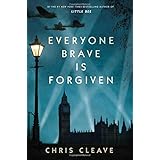
I've mentioned in many other posts that I've always been drawn to the World War II era, the literature, the history, the music, and even the clothes. I was surprised to read that British author Chris Cleave (http://chriscleave.com/) was venturing into historical fiction with his newest release and was looking forward to reading the autographed copy I picked up at Book Expo last month.
I was intrigued because in his talks with various audiences he explained (and does so again in the preface) that this novel is based upon actual letters sent back and forth between his grandparents during the war. I'm sure that this fact helped Cleave to put a very human face on the characters in "Everyone Brave is Forgiven."
This novel is absolutely about the horrors of war and its impact on the daily lives of those just trying to exist amid chaos, but it's also a book about other wars that were being fought simultaneously, class warfare, and racial warfare, specifically. Mary North, an idealistic young woman just out of what was euphemistically called "finishing school," is the daughter of upwardly mobile parents, her dad a rising politician, her mother in thrall to her husband's ambitions. The last thing they need is a daughter with a conscience!
But Mary wants to be useful. She has grandiose ideas of what she can do for the war effort, perhaps a spy? Instead, she is assigned to teach school. Horribly disappointed but willing to throw herself into it, she falls in love with the children, the more incorrigible the better. It doesn't hurt that she catches the eye of Tom, the principal, an unassuming young man, fearful of the war and plagued by guilt that he hasn't yet joined up like his more adventurous friend Alistair.
The more I read, the more I realize just how much we aren't taught in school. The siege of Malta is one of those appalling incidents that never crossed my radar screen and Cleave brings home the horrific bombing, the starvation, and the confusion of that lengthy battle vividly. Twenty-first century wars are brought to your computer screens in real time. It must be so difficult for younger readers to comprehend how the lack of reliable communication left families in the dark, lovers unsure, and friends confounded as months could go by without word from loved ones. Ships carrying bags of mail were often sunk so that whole swaths of peoples' written lives lay at the bottom of the sea.
Cleave writes somewhat awkwardly about another situation I was unaware of, the extreme prejudice shown toward black Americans working in the UK during the late '30's and early '40's. Mary takes up the cause of a young black boy in her class. Zachary, considered uneducable by previous teachers, suffers from what would be recognized today as dyslexia. Mary, challenges him to learn and when he's sent to the country along with the other children, during the height of the bombing, he corresponds with Mary in London. In fact, Mary reads between the lines, discovering that Zachary is being starved and abused by his "caretakers." Her intervention saves his life, a favor he will one day be able to return in full.
I had hoped to use this novel for one of my discussions at the library in Florida this winter but found that, although I enjoyed it and learned from it, I was too disappointed in Cleave's handling of Mary's awakening to racial disparity and her yearning to alleviate its unfairness. Cleave's continuous use of the word "nigger" throughout the book was disconcerting to say the least. It didn't seem necessary to make his point and became cringe-worthy after a while, particularly because he did such a wonderful, sensitive job with another book about race in a more modern Great Britain, "Little Bee."
Still, Mary is a fabulous character, and her friend Hilda, with whom she enters the ambulance service, is a sympathetic example of a woman completely out of her comfort zone yet willing to put herself on the line rather than observe from her well-appointed apartment while sipping champagne. Hilda matures from a self-absorbed socialite in search of a man to a woman who performs heroic deeds. For those of you who found pleasure in Kristin Hannah's "The Nightingale," Cleave's book will be just the ticket.


